
What is the Business Model Canvas?
The Business Model Canvas (BMC) is a framework with nine building blocks that describes how you create value, deliver it to customers and earn money from it. On one page, you connect your offer and customers to your channels, activities, partners, revenue and costs.
The model grew out of Alexander Osterwalder’s work and became known through Business Model Generation, the book he wrote with Yves Pigneur. The Dutch edition is called Business Model Generatie. The canvas helps you discuss and change a business model. It does not prove demand for your offer: that requires research and real customer responses.
The nine building blocks explained
The blocks are connected. A different customer segment may need a different offer. An additional sales channel may generate revenue, but also extra costs and work. Rather than filling in nine separate lists, check whether they tell a coherent story together.
1. Customer segments — who do you create value for?
Describe customers who share a relevant need. “Everyone who shops online” is too broad to guide decisions. Focus on their problem, buying behaviour and situation. Distinguish the user from the person paying when they are not the same.
An ideal customer profile (ICP) can help make your segment more specific. Check the profile against customer conversations and your own data.
2. Value propositions — why would someone choose you?
Your value proposition is the value you deliver to a particular customer segment. What problem do you solve? What outcome does your customer want? How does your offer differ from the alternatives, including doing nothing?
“High quality and good service” leaves many questions unanswered. Describe the benefit your customer experiences and what you can demonstrate. A product feature only becomes a benefit when it matters to the customer.
3. Channels — how do you reach customers and deliver your offer?
Channels cover more than advertising. Consider awareness, evaluation, purchase, delivery and support. Your website, webshop, email, sales partners and marketplaces may each play a part.
Connect this block to your online marketing strategy. Where does someone discover you? Where do they buy? What needs to happen afterwards? A channel with wide reach does not automatically generate profitable sales.
4. Customer relationships — how do you stay connected?
Describe the relationship your customer expects: personal advice, self-service, automated support or a community, for example. Distinguish attracting customers from keeping them and helping them further.
A self-service webshop and a business service with personal contact require different support. Record the time, people and systems needed for each relationship. Your customer journey helps identify the touchpoints.
5. Revenue streams — what do customers pay for, and how?
Describe what each segment pays for. This could be a one-off purchase, subscription, usage fee, licence or commission. A webshop selling its own products has a different revenue stream from a platform earning commission on partner sales.
Keep revenue and profit separate. Revenue can grow while costs grow faster. For subscriptions, retention and cancellations matter alongside new sign-ups.
6. Key resources — what do you need to deliver?
These are the essential resources behind your model: people, expertise, technology, inventory, brand, customer data or physical assets. Not everything you use is a key resource. Focus on what is necessary to deliver your value proposition.
A digital offer may depend on a working platform and specialist knowledge. E-commerce may depend heavily on inventory and reliable product information. Describe what you own, rent or access through partners.
7. Key activities — what must you do well?
Record the work essential to your offer. This might include product development, purchasing, order fulfilment, service delivery, platform management or customer support.
Marketing can be a key activity, but the canvas is not a complete task list. For each activity, ask: if we fail to do this well, can we still deliver what we promise? This separates essential work from supporting tasks.
8. Key partnerships — who do you depend on?
Identify suppliers, distribution partners, platform providers and others essential to your business model. Record what they contribute and why you work with them.
Consider dependency too. If nearly all customers arrive through one platform, a change in its terms can affect your model. A partner is not just a name on the canvas: the relationship affects delivery, reach and costs.
9. Cost structure — what costs does your model create?
Show the costs resulting from your resources, activities, channels and partners. These may include people, technology, purchasing, shipping, returns, marketing and support.
Distinguish fixed costs from costs that change with usage or sales. The canvas summarises them; you still need the underlying calculations. For a webshop, acquisition costs, platform commissions, shipping and returns can together determine whether a sale contributes anything.
How do you fill in a Business Model Canvas?
Start with one clearly defined business model. Do not mix your current situation with a new idea without making the distinction visible. An organisation with several business models may need several canvases.
- Define your question. Are you trying to understand your current model, explore a new offer or compare two sales models?
- Start with customer and value. Identify the segment and the need your offer meets.
- Connect the remaining blocks. Describe how you reach, sell, deliver and support, and what you need to do so.
- Make revenue and costs explicit. Check whether the way you earn fits the activities and resources required.
- Mark assumptions. Separate what you know from what you suspect and what is missing.
- Test the most important uncertainty. Consider customer conversations, a prototype or a limited test of your offer. Measure behaviour, not just enthusiasm.
- Update the canvas. Incorporate what you learn and record the decision it leads to.
There is no mandatory order for filling it in. Start where your question lies, but eventually consider all nine blocks. A completed sheet is a snapshot, not a finish line.
Using the canvas for a webshop
For a webshop, you can use the canvas to compare selling directly with selling through a marketplace. These are different choices, even when the product is identical.
With direct sales, you manage your own webshop and customer contact. That brings work and costs such as attracting visitors, payment processing and support. With a marketplace, reach and sales partly come through another platform, with its own terms, commissions and access to customer data.
The channel choice also changes your customer relationships, key partners, activities and cost structure. Compare those differences. Then use your own figures to check what remains after purchasing, marketing, commissions, delivery and returns. Comparing revenue alone does not give the full picture.
To explore the online sales channel further, read about webshops and conversion.
The book Business Model Generation
Business Model Generation by Alexander Osterwalder and Yves Pigneur covers understanding, designing and renewing business models. Alongside the canvas, it discusses patterns, design techniques and ways to explore strategic choices. Its Dutch edition is called Business Model Generatie.
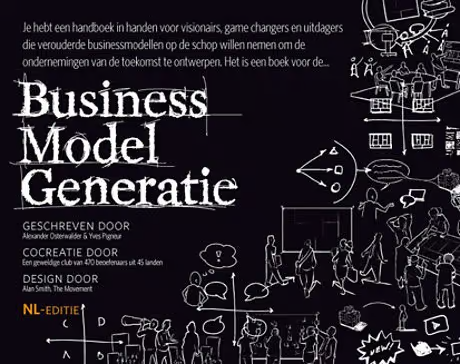
The supplied image shows the Dutch book, not the blank Business Model Canvas. For the original canvas template, visit Strategyzer: Business Model Canvas.
View Business Model Generation on bol
This is an affiliate link. If you buy through it, we may receive a commission. The link opens search results on bol; check the title, language and edition there.
What the canvas cannot solve for you
The canvas provides an overview, not proof of a working model. A sentence in the customer segments block does not replace customer research. A revenue stream on paper says nothing about willingness to pay. A cost block is not a financial forecast.
Competition, market developments and execution also need further work. Use the canvas to reveal questions, not to hide uncertainty. A story that convinces people internally may still conflict with what customers actually do.
Frequently asked questions
Who developed the Business Model Canvas?
The Business Model Canvas grew out of Alexander Osterwalder’s work. He co-authored Business Model Generation with Yves Pigneur. The book, called Business Model Generatie in Dutch, centres on the model.
Is the Business Model Canvas the same as a business plan?
No. The canvas summarises a business model on one page. A business plan also develops areas such as the market, execution, risks and financial expectations. The canvas can be a starting point for it.
How does it differ from the Value Proposition Canvas?
The Business Model Canvas describes the whole business model. The Value Proposition Canvas focuses on a customer segment and your offer: customer jobs, pains and desired gains, and how your products or services address them. The two models complement each other.
Can you use the canvas for an existing business?
Yes. You can describe your current model, identify weak connections and compare alternatives. Create a separate canvas for a new version so that facts about today do not get confused with assumptions about tomorrow.
Do you need to fill in all nine blocks?
Consider all nine, but do not present missing knowledge as fact. Mark what you still need to investigate. The connections between the blocks matter more than a completely filled sheet.
Sources and further reading
- Strategyzer — The Business Model Canvas: the model, nine blocks and application.
- Strategyzer — Business Model Generation: Osterwalder and Pigneur’s book.
- Strategyzer — The Value Proposition Canvas: a closer look at customers and offers.
- Strategyzer — Roadmap to test your value proposition: testing assumptions.
- Strategyzer — How business models help generate business plans: the canvas and business plans.
 Preferred source on Google
Questions, or just want to spar?
We're happy to think along — call, email or drop by in the heart of Eindhoven.