
SEO tools compared: Semrush, Ahrefs and Mangools
You can do SEO by gut feel. Write a page, hope Google picks it up, and occasionally Google your own company name. That works about as well as running ads without ever looking at your numbers.
Once you start taking SEO — and by now also GEO, i.e. visibility in AI answers from ChatGPT, Gemini and Google's AI Overviews — seriously, you need data. How many people actually search for a term? What's it worth commercially? Who's ranking at the top now, and why? Which topics does your competitor cover that you don't? That's exactly what SEO tools are for.
In this article we walk through the key features, explain why they're useful, and compare the three tools you'll most often come across in practice: Semrush, Ahrefs and Mangools. Spoiler: if you just want to get started without spending a small fortune every month, Mangools is the most logical first step.
Why you can't do without an SEO tool
Google Search Console and Google Analytics are free and indispensable, but they have one big blind spot: they only show you what's already happening on your own site. They tell you nothing about:
- search volumes for terms you're not yet found for
- what advertisers pay per click (and therefore how commercial a term is)
- how hard it is to rank in the top 10 for a term
- who links to your competitors — and could therefore also link to you
- which topics your competitor covers that you're missing
- how your positions develop day by day, including on mobile and by location
An SEO tool fills exactly that gap. The difference between "I think this is a good topic" and "2,400 people a month search for this, the CPC is €4.10 and competition is low" is the difference between a hobby and a strategy.
1. Keyword research: volumes, difficulty and CPC
This is the foundation, and immediately the feature you'll get the most out of. Enter a single term and the tool returns hundreds of variants, each with:
- Search volume — how many searches per month (and the 12-month trend, so you can spot seasonal peaks)
- Keyword difficulty (KD) — a score from 0 to 100 indicating how strong the current top 10 is
- CPC — what advertisers pay on average per click. High CPC = commercial intent. A term with 300 searches and a CPC of €8 is often worth more than a term with 8,000 searches and a CPC of €0.10
- SERP overview — who currently ranks, along with their authority and backlink profile
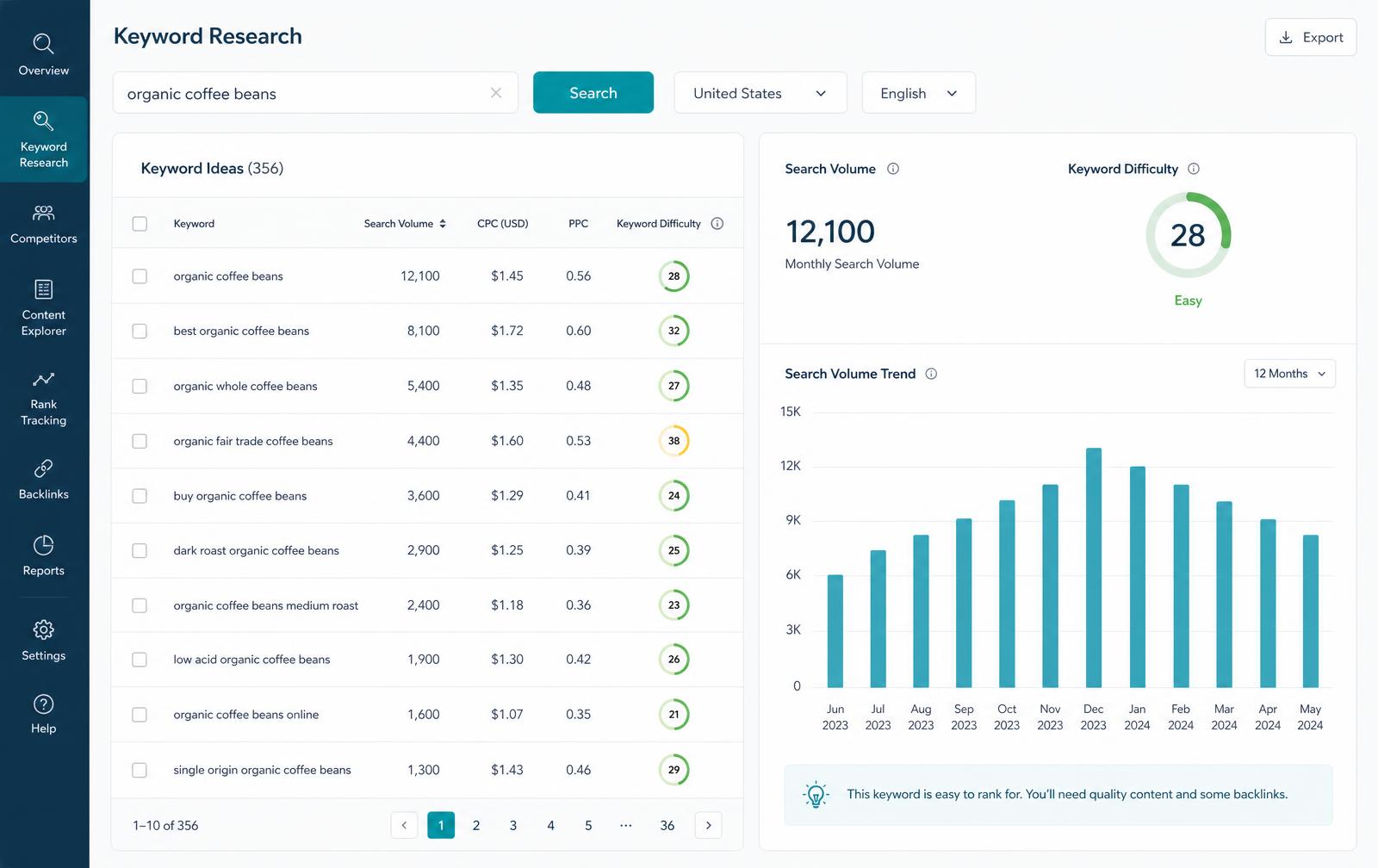
What you actually do with this: build a list of promising keywords with plenty of intent and little competition, group them by topic (clusters), and then decide which pages to create. Skip this step and you'll write pages nobody searches for, or pages you'll never rank for.
Want to try this straight away on your own topic? You can do so for free in KWFinder by Mangools — type in your term and within a minute you'll see volume, difficulty and CPC.
2. Competitor analysis and content gap
Your competitors have already worked out what works. A good tool shows you their entire organic profile: which keywords they rank for, which pages bring in their traffic, and how much that traffic is worth.
The most powerful version of this is the content gap (also known as a keyword gap): a list of keywords that two or three competitors rank for and you don't. That's literally your content calendar, sorted by opportunity.
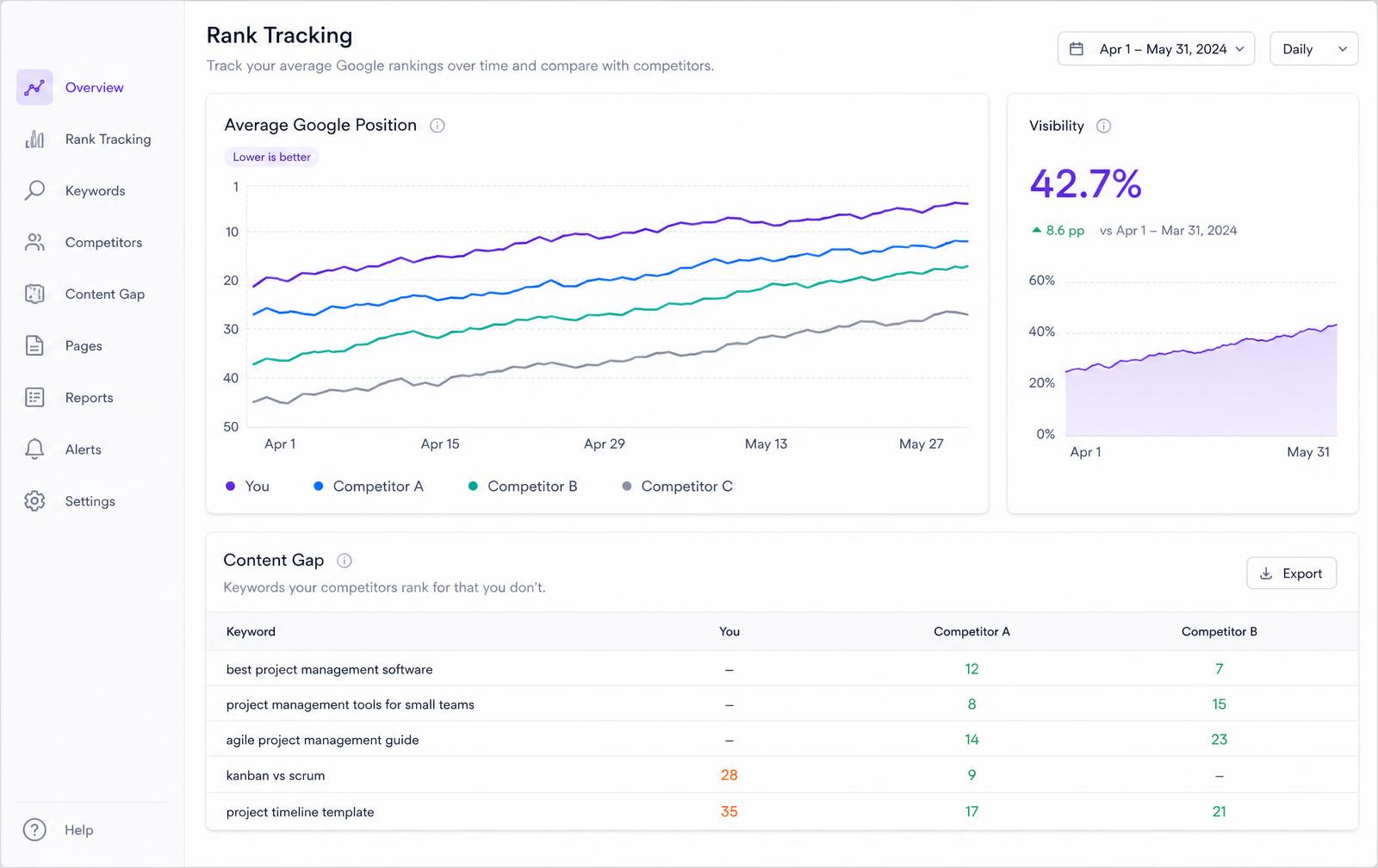
In practice we use it like this:
- Identify 3 to 5 real competitors (not the biggest names in the market, but businesses of similar size).
- Pull the content gap and filter for keywords with decent volume and low difficulty.
- Group by theme. Often you'll find you don't need 40 separate articles, but 5 solid pillar pages with supporting articles.
3. Backlinks: authority is still currency
Links from other websites remain one of the strongest ranking signals — and the only signal you can't arrange entirely on your own site. A backlink tool gives you:
- Authority score of your domain (Authority Score in Semrush, Domain Rating in Ahrefs, Link Strength in Mangools)
- Referring domains — more important than the total number of links: a hundred links from one site say less than ten links from ten sites
- Follow/nofollow ratio and the quality of the linking sites
- Anchor texts — a profile where 40% consists of the exact same commercial anchor looks unnatural
- New and lost links — noticing that five good links disappeared this month is valuable information
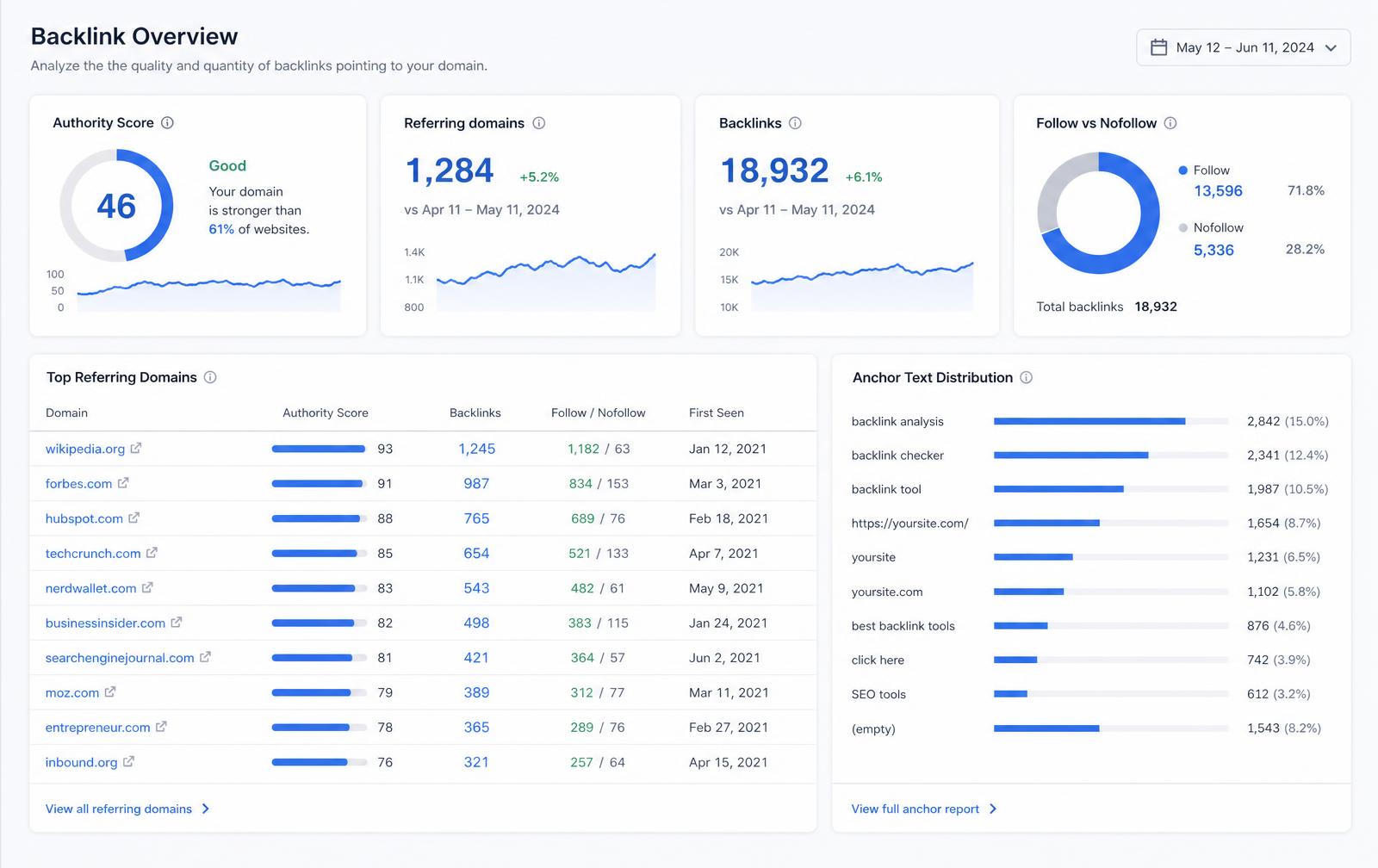
The practical application is called the link gap: analyse who links to your three main competitors but not to you. These are trade publications, industry associations, partners and local platforms that clearly find your topic interesting. That's a far more useful link-building list than cold outreach.
4. Site audit: getting the technical basics right
A site audit crawls your website the way Google does, and gives you a prioritised list of issues:
- pages that return a 404 or a redirect chain
- missing or duplicate title tags and meta descriptions
- pages accidentally set to
noindexor blocked inrobots.txt - slow pages, oversized images, Core Web Vitals
- missing structured data (schema.org) — increasingly important for GEO too, since it helps AI systems interpret your content
- internal links: which pages get too few internal links and end up buried
This is the least glamorous and often the most profitable feature. A page can be beautifully written and still be invisible if it's technically unfindable.
5. Rank tracking: measuring whether it's working
Tracking keywords in a tool gives you something Search Console doesn't: daily, reliable positions per keyword, per device and per location, alongside your competitors' positions.
Why that matters: SEO works with a delay. Without tracking, you won't know whether the page you rewrote in March actually moved from position 24 to 7 by May. With tracking, you can decide where your next hour of work will pay off most — often not in new content, but in improving a page that's hovering just outside the top 10.
For local businesses the location setting is essential: "hairdresser Eindhoven" looks completely different from Eindhoven than it does from Amsterdam.
6. GEO: visibility in AI answers
New, and quickly becoming more important. More and more searches now end in an AI answer rather than a click. The major tools now offer reporting on whether your brand appears in AI Overviews and in answers from ChatGPT or Perplexity, and which sources actually get cited there.
The optimisation itself doesn't differ hugely from good SEO: clear, factual content, a logical structure, schema markup, authority and brand mentions in places AI models trust. What changes is the measurement — and for that you need a tool that tracks it.
Want to see how visible you are in AI? Use the AI visibility checker by Mangools
Mangools has a dedicated tool for this: AI Search Watcher. You enter your brand and it shows when and where you're mentioned in AI answers.
- Enter your brand. The tool suggests brand-relevant prompts, or you add your own. Setup takes about thirty seconds.
- Every prompt runs multiple times. AI answers aren't consistent, so repetition gives you average positions, a visibility score and more citation variants instead of a single snapshot.
- You get a report per AI search engine. It currently tracks eight: ChatGPT, Google AI Overviews, Google AI Mode, Gemini, Claude, Grok, Mistral and Llama.
- You compare competitors. Track competing brands side by side and see where they get cited and you don't.
- You see how AI describes your brand. Not just whether you're mentioned, but how — and where that differs from your own positioning.
Rank tracking measures your position in Google's results; AI monitoring measures whether your brand appears in the generated answer. Treat the numbers as direction rather than exact truth: these models and interfaces change often.
👉 Check your AI visibility with AI Search Watcher
The three tools side by side
| Mangools | Semrush | Ahrefs | |
|---|---|---|---|
| Strongest point | Ease of use and price | Breadth: SEO, ads, social, PR | Backlink data and site audit |
| Keyword research | Very good and clear | Very comprehensive | Very comprehensive |
| Backlink index | Limited but usable | Large | Largest, most detailed |
| Site audit | Basic (SiteProfiler) | Comprehensive | Comprehensive and technically deep |
| Rank tracking | Included (SERPWatcher) | Included, extensive | Included |
| Content gap / keyword gap | Limited | Excellent | Excellent |
| Advertising data (CPC, competition) | Basic | Extensive | Basic |
| Learning curve | Very low | High | Medium |
| Price level | Low (± €30–60/month) | High (from ± €140/month) | High (from ± €110/month) |
Semrush
The Swiss Army knife option. Alongside SEO you get advertising data, social, rank tracking, PR and a huge pile of reporting. Ideal if SEO is part of a broader marketing team and you want to analyse multiple channels side by side. Downside: it's a lot, and you pay for modules you may never open.
Ahrefs
The favourite among SEO specialists, mainly thanks to the backlink index and the quality of the site audit. If link building and technical SEO are your focus, Ahrefs is the sharpest choice. Also pricey here, with an interface that assumes you already know what you're looking at.
Mangools — the best first step
And then Mangools. Five tools in one subscription: KWFinder (keywords), SERPChecker (SERP analysis), SERPWatcher (rank tracking), LinkMiner (backlinks) and SiteProfiler (domain overview) — plus AI Search Watcher for your visibility in AI answers. What makes it stand out:
- The price. A fraction of Semrush or Ahrefs. For most SMEs and freelancers, that's the difference between having a tool or not — and no tool is always the worst option.
- The ease of use. Where Ahrefs and Semrush dump you into a dashboard with thirty menu items, Mangools gives you one clear screen with exactly the numbers you need to decide: volume, difficulty, CPC and the current top 10. No course required.
- It's enough for 80% of the work. Keyword research, building clusters, reviewing competitors in the SERP, tracking positions and checking your backlink profile — it all fits.
In short: start here. If you later find yourself hitting the limits of the backlink index or the content gap features, step up to Ahrefs or Semrush. But by then you'll know exactly what you're paying for.
👉 Check out Mangools — or go straight to your first keyword research in KWFinder.
How we approach it in practice
A tool isn't a strategy. The order that works best for us:
- Keyword research — map out volumes, intent and CPCs, clustered by topic.
- Competitor and content gap analysis — what's already working in your market and what you're missing.
- Site audit — get the technical foundation and internal links in order, so new content can actually rank.
- Create and improve content — start with existing pages around position 8–20, that pays back fastest.
- Build authority — links and brand mentions via the link gap list.
- Measure and adjust — rank tracking, Search Console and revenue side by side. An hour every month, not a quarter full of assumptions.
To sum up
SEO tools make your visibility measurable, and what's measurable becomes manageable. Whether you choose Semrush, Ahrefs or Mangools, the main thing is that you stop guessing. Want to start small and affordably? Then Mangools is simply the smartest choice — and with KWFinder you can do your first research today.
Would you rather figure out together where your biggest opportunities lie? We're happy to think along with you.
Questions, or just want to spar?
We're happy to think along — call, email or drop by in the heart of Eindhoven.