
Similarweb is a market research platform that estimates how many visitors almost any website in the world gets, where that traffic comes from and who those visitors are. You enter a domain and you see monthly visitor numbers, the split across organic, paid, social and email, engagement metrics such as bounce rate and pages per visit, search terms the site is found on, and an audience profile — including for sites you have no access to yourself.
Below: what it is, where the data comes from, what the free version and the paid packages give you, how accurate the numbers are, and where it fits in your set of tools.
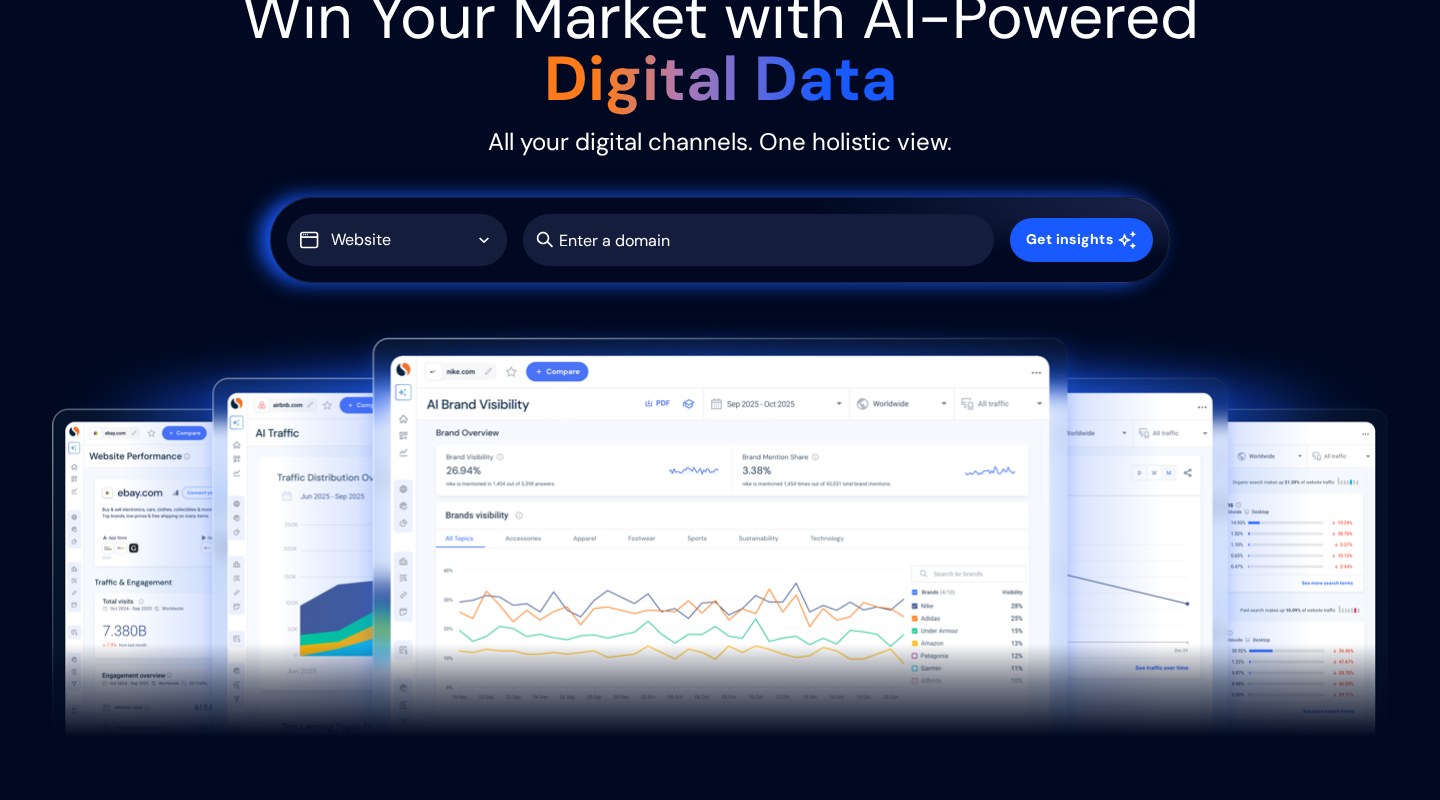
What is Similarweb?
Similarweb is a digital intelligence platform from Israel, founded in 2007 in Tel Aviv and listed on the New York Stock Exchange since May 2021 (ticker SMWB). It estimates traffic, channel mix, search terms and audience characteristics for more than a billion websites and apps — without you having to install anything on those sites (MakerStack, July 2026, SyncGTM, June 2026).
Beyond Website Intelligence, the suite includes more modules: App Intelligence (mobile apps), Retail Intelligence (Amazon sales), Sales Intelligence (which companies are researching your market) and AI Search Intelligence. The common thread: it answers every question your own analytics cannot, because it is not about your site.
Where does the data come from?
From a mix of sources: anonymous measurement data from browser extensions and apps, partnerships with internet providers, proprietary measurement panels and crawlers that scan the web. Similarweb combines those sources into an estimate of a site's traffic and audience (SyncGTM, June 2026).
That is also the most important thing to remember: the numbers are estimates, not measurements. For large websites the trends and ratios are reliable; for smaller sites the estimate can be well off. Published analyses cite deviations of 20 to 40 percent, and up to 40 to 60 percent for sites under 100,000 visits per month (Hans Dekker, February 2026, Spike AI, July 2026).
What can you do with Similarweb?
| Use case | What you see | What it is useful for |
|---|---|---|
| Competitor analysis | Traffic, engagement and channel mix of any website | Establishing where you stand relative to the rest |
| Market research | The share of every player in a category | Estimating market size and growth |
| Search terms | What a competitor ranks for organically | Topics and terms for your own content |
| Channel comparison | Where traffic comes from, per player | Choosing priorities in your own marketing mix |
| Audience profile | Age, gender, interests, other sites visited | Positioning and ad targeting |
| AI visibility | Traffic via AI answers and whether your brand appears | Seeing whether you show up in ChatGPT, Gemini and AI Overviews |
That last row is new and growing fast. Similarweb measures how much traffic sites receive through AI assistants and which brands are named in those answers (the "Gen AI Intel" module on the Similarweb packages page, September 2026). As an ever-larger share of searching ends in an AI answer instead of on a site, that is a channel you also want to know where you stand in.
Free vs paid
Similarweb is free to use, with clear limits. This is what you get:
| Free (site or free account) | Paid, self-serve packages | |
|---|---|---|
| Look up a site's traffic | Yes, limited history | Yes, 3 to 6 months of history |
| Search term research | Top terms only, limited | Full research, in the SEO packages |
| Competitor comparison | Limited number of sites and points | Full, with alerts on changes |
| AI visibility (AEO) | No | 150 tracked prompts, sentiment, citations |
| Ad insights | No | Only in the Ads package |
| Export, alerts, API | No | Yes, plus more users at extra cost |
The free side has three layers: tools on the site without an account (such as looking up a domain's traffic), a free account with more features, and a 7-day trial with all paid features — for which you leave a credit card and are limited to 15 actions per day (Similarweb blog, June 2024).
The paid self-serve packages look like this (prices as of September 2026, Similarweb pricing page):
| Package | Price per month | What you get |
|---|---|---|
| Competitive Intelligence | $125 billed annually, $199 monthly | Traffic, engagement, audience, channel overview; 3 months of history; 1 user |
| Competitive Intel & SEO & AEO | $333 billed annually, $399 monthly | Everything above plus: keyword research, rank tracking, site audit, backlinks, AI visibility |
| Competitive Intel, SEO & AEO & Ads | $542 billed annually, $649 monthly | Everything above plus: competitor advertising insights |
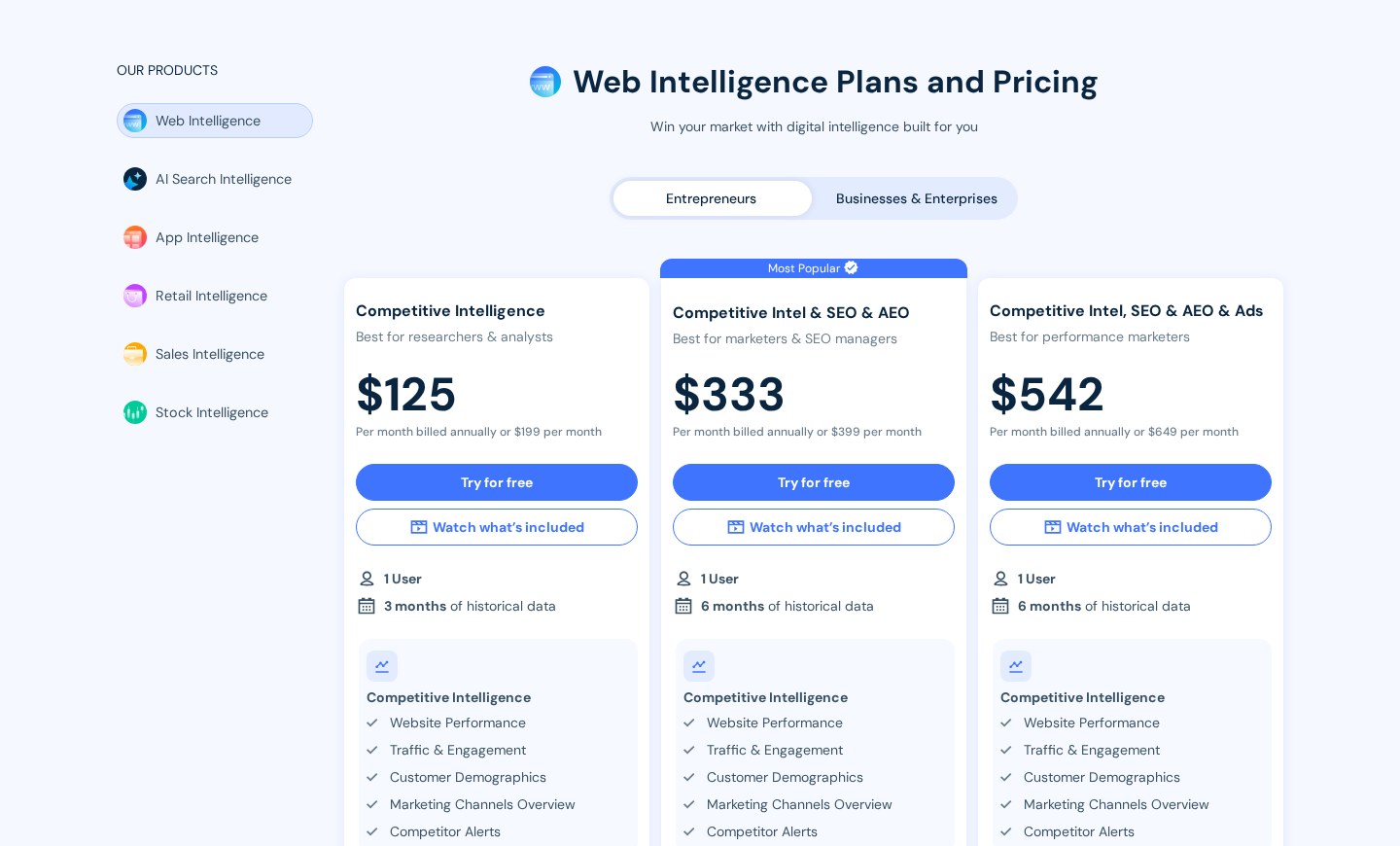
Three things to know. Prices vary by country, so what you see may be lower or higher (SaaS Price Pulse, September 2026). Business and enterprise packages are quote-only; published analysis puts the realistic entry point for serious team use around $14,000 per year (Spike AI, July 2026). And if you mainly need keyword data, backlinks and site audits, an SEO tool gets you there for less.
How to get the most out of it
You get the most out of it when you don't just look up the insight, but record it and act on it:
- Start with your own site. Enter your own domain and look at the channel mix and audience the outside world sees. That is your market baseline.
- Pick 3 to 5 real competitors — not the biggest names, but organisations of comparable size that want to be found on the same questions. Put them side by side in the competitor comparison.
- Look at ratios, not counts. "Does the competitor get most traffic via organic or paid" is more useful than "they get exactly 214,000 visits per month".
- Pull out the top search terms. The terms that bring a competitor the most organic traffic are an excellent topic list for your own content.
- Check your AI visibility. Do competitors appear in AI answers while you don't? That is a concrete to-do, not an opinion.
- Try before you buy. Use the free layers first. Only when you run into limits on history, alerts or exports is a package worth considering — and the 7-day trial lets you discover that without paying straight away.
The most common pitfall: presenting Similarweb numbers as facts. It is an estimate built on panels and measurement data. Steer on direction and you will go far; steer on the third decimal and you are steering on chance.
Where it fits in your tool mix
Similarweb complements what other tools do not do. Here is how the layers connect:
| Layer | Tool | The question it answers |
|---|---|---|
| Your own site, exact numbers | Google Search Console, GA4 | What is happening on my site? |
| Search terms, technical work, links | SEO tools such as Semrush, Ahrefs and Mangools | What should I rank for, and how? |
| Market and competitors | Similarweb | How is the market performing and where do I stand? |
| Conversion and behaviour | Microsoft Clarity and A/B testing | Where do visitors drop off? |
Where keyword research and backlinks belong in an SEO tool, Similarweb is about the market itself: who gets how much traffic, through which channels and from which people. For that SEO part compared side by side, read our article on SEO tools: Semrush, Ahrefs and Mangools compared. And for the part where you know exactly what happens on your own site, start with measurement and attribution.
Where it falls short
Being honest about the limits: Similarweb is not the tool for everything.
- Small sites are too small to model. Below roughly 100,000 visits per month the estimate becomes broad, exactly where you want the number most. For decisions about such a site, your own analytics serve you better.
- Team pricing is opaque. Business and enterprise packages run through quotes, and add-on modules (API, extra data feeds, extra seats) push up the bill (Spike AI, July 2026).
- No contact details. Sales Intelligence shows which companies are researching your market, but does not deliver email addresses or phone numbers; for that you need a separate tool (SyncGTM, June 2026).
- It does not answer strategy questions. Similarweb tells you what is happening, not what to do. Translating that into a plan is your own work — or your agency's.
Frequently asked questions
Is Similarweb free?
Yes, but limited. On the site you can look up any website's traffic for free, and a free account adds keyword research and competitor comparison. Full features and longer history sit in paid packages from $125 per month billed annually. To try the paid features first, you can start a 7-day trial.
How accurate is Similarweb?
The numbers are estimates, not measurements. For large websites the trends and ratios are reliable, but for smaller sites the estimate can be well off: published analyses cite deviations of 20 to 40 percent, and up to 40 to 60 percent for sites under 100,000 visits per month. Use it to determine direction and ratios, not to steer on exact counts.
Where does the data of Similarweb come from?
From a mix of sources: anonymous measurement data from browser extensions and apps, partnerships with internet providers, proprietary measurement panels and crawlers. Similarweb combines those sources into an estimate of a site's traffic and audience. The fewer sources available for a site, the greater the uncertainty.
How much does Similarweb cost?
The cheapest self-serve packages for a single user start at $125 per month billed annually ($199 per month billed monthly), with three months of history. Packages with keyword, AI visibility and advertising features cost $333 and $542 per month billed annually. Business and enterprise packages are quote-only (prices as of September 2026; they vary by country).
Can I see a competitor's traffic?
Yes. That is exactly the strength of Similarweb: you see an estimated number of visitors a competitor gets, where the traffic comes from and which search terms and pages contribute. For smaller competitors that estimate is less precise; for larger sites the direction is usable.
What is the difference between Similarweb and Semrush?
Semrush and similar tools mostly provide keyword data, backlinks and site audits. Similarweb models a site's entire visitor picture, with channel mix, audience and market share. In practice they complement each other: search terms and technique from an SEO tool, the market and competitor layer from Similarweb.
What is AI Brand Visibility?
A feature that measures whether your brand appears in answers from AI assistants such as ChatGPT and Gemini, on which questions and with what tone. Similarweb calls that set AEO Intelligence and links it to the traffic sites receive through AI answers. Interesting as a growing share of searching ends in an AI answer instead of on a site.
For whom is Similarweb not the best choice?
If you mainly need keyword research, backlinks and site audits, an SEO tool gets you there for less. For small sites the data is too inaccurate to steer on. And for finding contact details or prospects: the platform is not built for that.
Questions, or just want to spar?
We're happy to think along — call, email or drop by in the heart of Eindhoven.